








Author

What is the Digital Personal Data Protection Act (DPDP Act)?
Imagine this scenario where you have lined up an ambitious expansion for 2026 with new markets in Europe, with a global customer-facing app and seamless supply chains across borders. Everything is initiated for launch. Suddenly, India’s new Data Privacy Regulations create major roadblocks, freezing your data transfers, imposing crippling fines, and driving away potential customers. This is not a hypothetical situation.
The Digital Personal Data Protection Act, 2023 (DPDP Act) has become fully operational through Digital Personal Data Protection Rules, 2025 (DPDP Rules), which the Government of India had notified in the late 2025. The rules are portrayed with a phased compliance timeline that began on November 13, 2025, when the Data Protection Board of India (DPB) started functioning. Any business handling personal data faces serious risks if it fails to comply. These regulations could derail your growth plans faster than expected.
Key Compliance Requirements Under DPDP Rules 2025
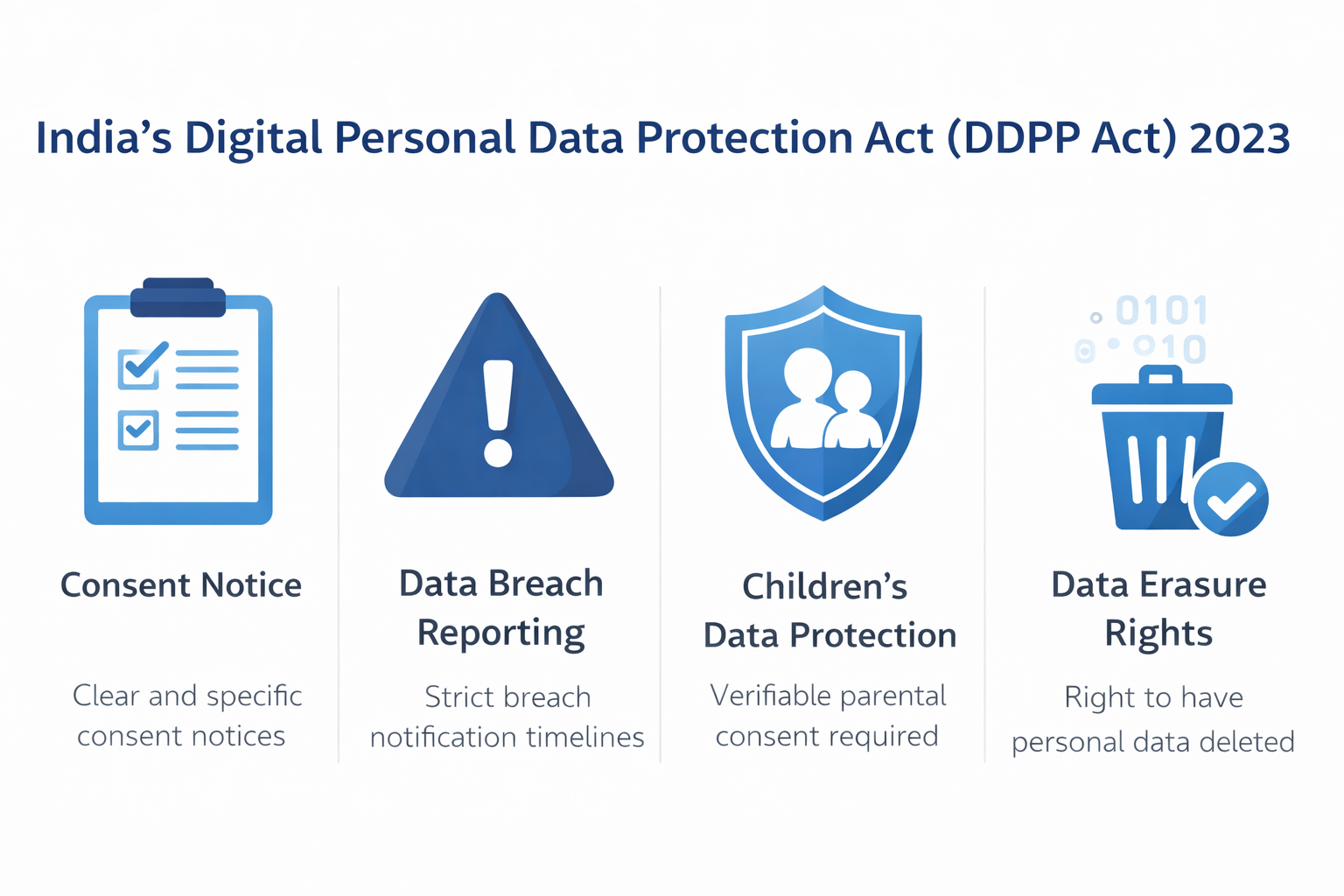
The Digital Personal Data Protection Rules establish clear operational requirements. Businesses must now provide crystal clear consent notices that provide explanation on exactly what personal data they collect and for what specific purposes. Customers gain the right to demand data erasure at any time. Companies face strict timelines for notifying authorities and affected individuals about data breaches. Children’s data receives special protection, requiring verifiable parental consent before any processing occurs.
The Data Protection Board serves as the central enforcement authority, handling complaints, conducting investigations, and also imposing fines or penalties. Larger entities designated as Significant Data Fiduciaries (SDFs) face heightened scrutiny based on the volume and sensitivity of data they handle. Smaller firms benefit from the phased rollout, but the major players must act immediately to avoid disruptions.
Cross-Border Data Transfers Under the DPDP Act
Cross-border data transfers prevent the biggest challenges for companies with international ambitions. The European Union’s GDPR under Articles 44-50 imposes stringent restrictions on transferring personal data from European Union countries to nations with lower protection standards. Non-compliance leads to substantial costs, legal uncertainties, and potential requirements for data localization, where companies must keep all data within India’s borders.
European Union adequacy decisions offer a solution by certifying that a country provides an “essentially equivalent” level of protection, enabling unrestricted data flows. However, obtaining such decisions prove difficult.
GDPR Restrictions and the Schrems II Case
The Schrems II case (Case C-311/18) from the Court of Justice of the European Union illustrates these challenges in a clear manner. The Court invalidated the European Union- United States privacy shield framework because United States surveillance laws failed to adequately protect the European Union personal data. This ruling established that transfers to non-European Union countries require protections that match European Union standards. Companies typically rely on the Standard Contractual Clauses (SCCs) combined with Transfer Impact Assessments (TIAs) to demonstrate compliance.
The Digital Personal Data Protection Act adopts a more flexible “negative list” or whitelist approach. Data transfers remain permissible to any country except those specifically restricted by Government notification. Businesses can facilitate these transfers through explicit consent from data subjects, Government-approved contracts, or recognized adequacy decisions.
India’s negotiations for European Union adequacy decision have progressed slowly since 2025 through the India-European Union Digital Dialogues. Concerns about independence of India’s Data Protection Board pose significant hurdles. Experts predict delays until 2028-29 unless India make further amendments to align more closely with GDPR requirements. In the meantime, companies must use Standard Contractual Clauses (SCCs) or seek approval from the Data Protection Board for intra-group transfer schemes. Businesses planning European expansion should conduct immediate audits of their data flows and prepare appropriate contractual safeguards.
Consent Management Requirements Under the DPDP Rules
Consent management represents another critical area where companies frequently stumble. Under the Digital Personal Data Protection Rules, consent must meet strict criteria. It needs to be free, specific, informed, unconditional and obtained through clear affirmative action from the data subject. Withdrawal of consent must occur through a process that proves at least as simple as granting it. Companies cannot bundle consent across multiple unrelated purposes. Several common pitfalls trip up businesses.
Many mix consent notices with lengthy terms of service documents, making them difficult to understand. Others fail to provide notices in all 22 scheduled Indian languages as required. Companies handling data across multiple fiduciaries often overlook the need for Consent Managers. Significant Data Fiduciaries face additional requirements for granular, purpose-specific consent prompts that leave no ambiguity.
Penalties Under the DPDP Act
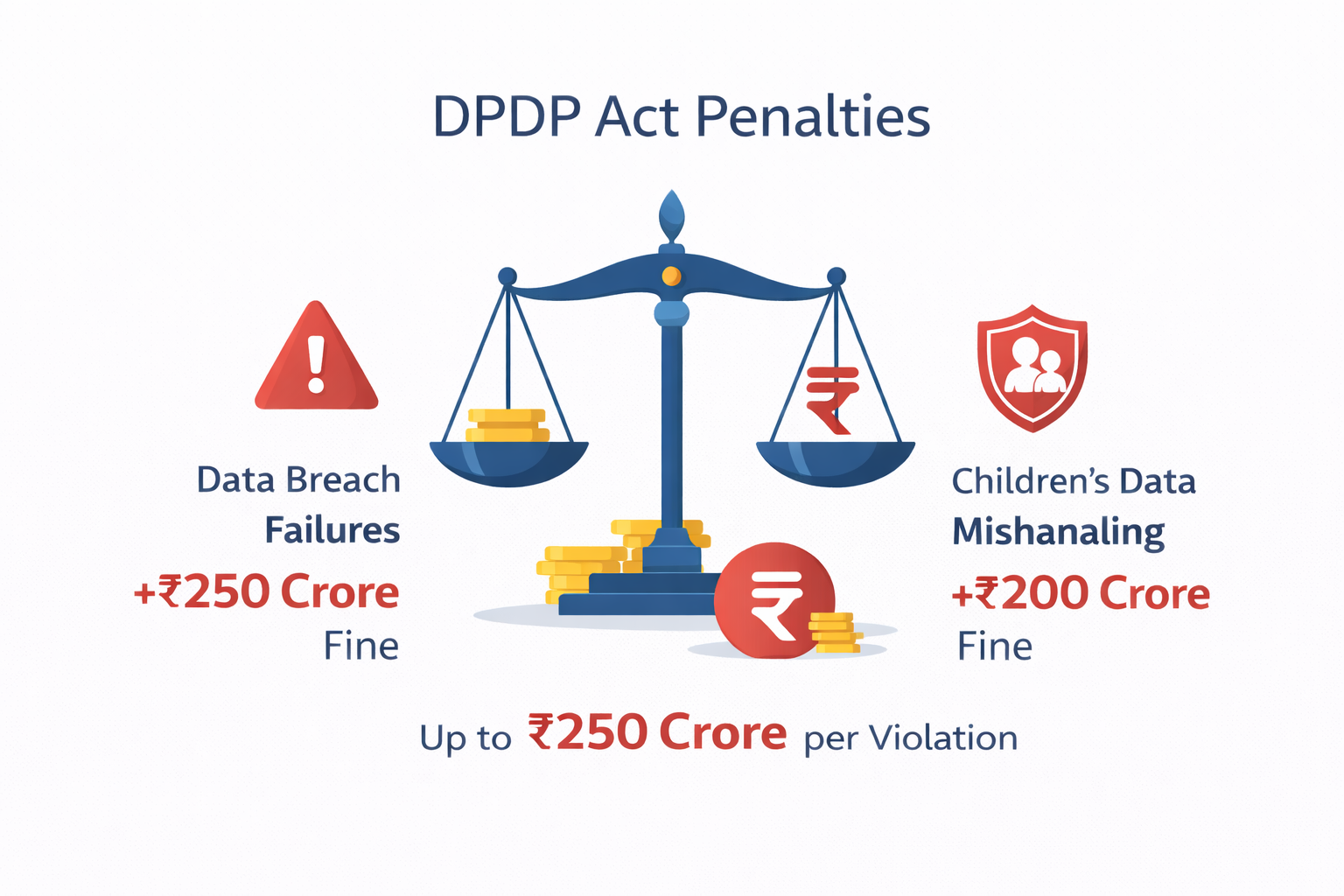
The penalty structure emphasizes deterrence through significant financial consequences. The Data Protection Board can impose fines up to Rs 250 Crore for each violation, creating substantial risks for non-compliant companies. While not structures exactly as a flat 4% of global turnover such as GDPR, the capped amounts remain high enough to cause serious damage. Specific violations carry targeted penalties. Core data breach failures attract fines up to Rs 250 Crore. Mishandling of Children’s data result in penalties up to Rs 200 Crore.
Significant Data Fiduciaries face up to Rs 150 Crore for failures such as not appointing a Data Protection Officer or skipping required audits. The Data Protection Board prioritizes enforcement actions that send strong deterrent messages. Companies can appeal decisions to the Telecom Dispute Tribunal, but prevention through proper compliance proves far more effective than facing penalties.
Impact of the DPDP Act on Fintech and Healthtech Companies
Sector-specific impacts create particular challenges for high-growth industries. Fintech companies handling sensitive financial data frequently qualify as Significant Data Fiduciaries due to the volume and sensitivity of information they process. These firms must navigate overlapping regulatory requirements from the Reserve Bank of India (RBI) and CERT-In (Indian Computer Emergency Response Team), which mandate breach reporting within 6 hours, alongside additional Data Protection Board notifications.
Know Your Customer (KYC) processes face complications because companies cannot rely on behavioural tracking for consent. Healthtech companies encounter similar pressures. They must enable data principals to access and delete their information promptly, creating tensions with record keeping requirements similar to HIPAA standards. Processing Children’s data requires stricter verifiable parental consent mechanisms. High-risk processing activities demand comprehensive Data Protection Impact Assessments (DPIAs).
5-Step DPDP Compliance Roadmap for Businesses
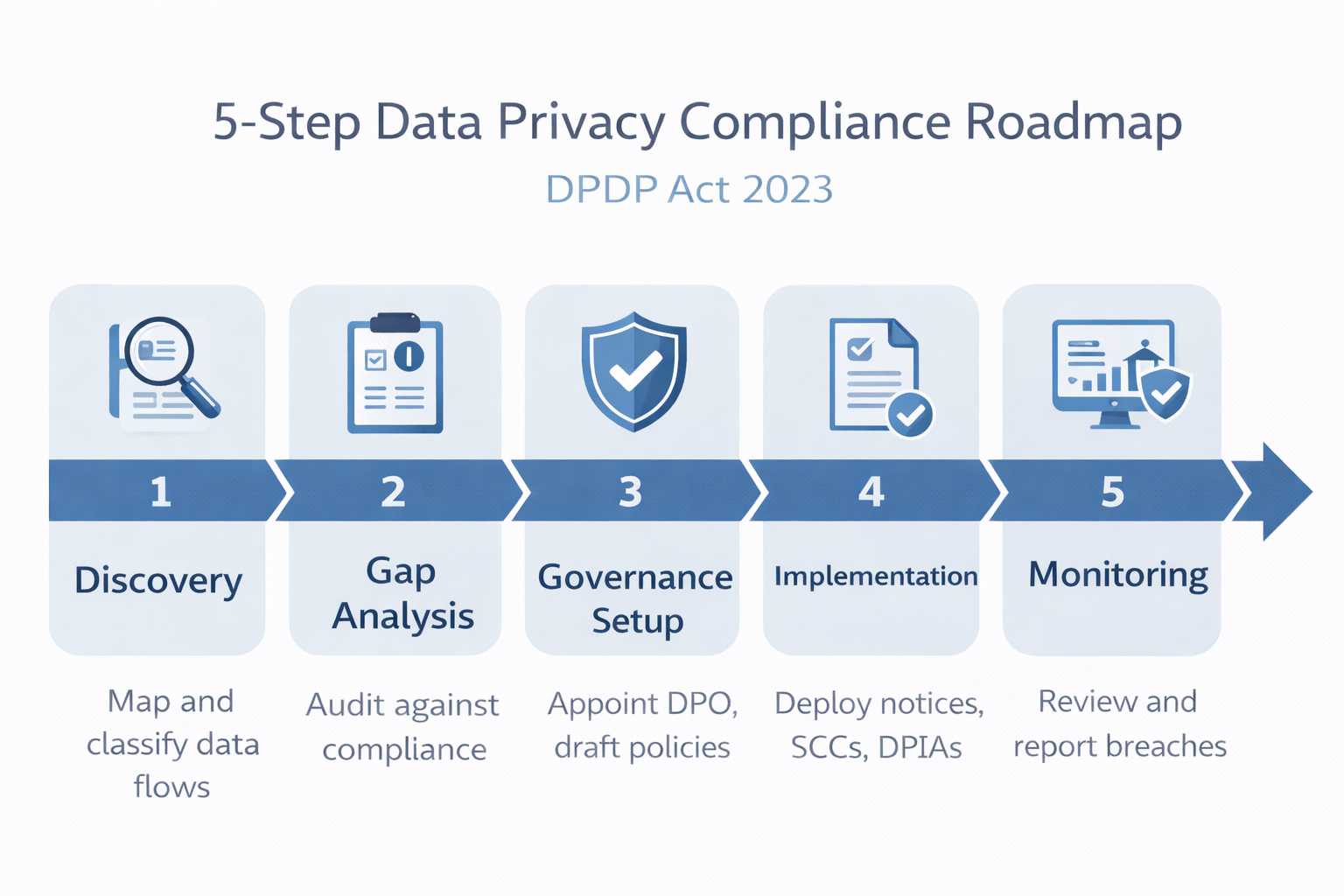
Companies can implement compliance through a structured five-step roadmap. The first step involves discovery, where businesses spend around 1-2 months mapping all data flows, identifying who collects, stores, and shares personal data, and classifying whether they qualify as fiduciaries or Significant Data Fiduciaries. Step two focuses on gap analysis, taking about one month to audit current practices against Digital Privacy Data Protection requirements and identify specific deficiencies in notices, transfers, or consent mechanisms.
Step three involves Governance Setup, requiring 1-2 months to appoint required Data Protection Officers, draft comprehensive policies, and register with Consent Managers if applicable. Step four represents implementation, spanning 2-3 months to deploy new notices and consent tools, update contracts with SCCs, train employees, and conduct necessary Data Protection Impact Assessments (DPIAs). The final step involves ongoing monitoring through annual reviews, breach response protocols, and regular Data Protection Board reporting, with independent audits required for Significant Data Fiduciaries.
Real-World DPDP Compliance Examples
Real-world examples demonstrate both successes and failures. A leading Bangalore-based fintech company achieved early compliance by conducting thorough Transfer Impact Assessments, which helped secure European partnerships and boosted revenue by 40%. A healthtech pioneer designed child-safe applications with robust parental consent mechanisms, successfully navigating multiple regulatory audits without penalties. Conversely, a major e-commerce platform suffered a Rs 100 Crore penalty for bundling inappropriate consents across multiple purposes. A multinational corporation experienced stalled expansion when European regulators blocked data transfers due to inadequate TIAs (Transfer Impact Assessments).
Why DPDP Compliance is Critical for 2026 Business Expansion
The data privacy landscape in 2026 clearly favours prepared companies. Those achieving compliance position themselves to attract premium partnerships, top talent, and discerning investors who prioritize data security. Non-compliant businesses face sunk compliance costs, regulatory investigations, and stunted growth opportunities. The choice becomes straightforward: invest in systematic Digital Personal Data Protection compliance now, or risk watching expansion plans unravel through avoidable regulatory pitfalls.
Companies which are serious about their 2026 growth should take immediate action. In 2026’s data-driven race, Digital Personal Data Protection compliance is not just a checkbox, it is your expansion’s lifeline. Smart Corporates will follow mapping flows, nailing consents and bridging cross-border gaps todays will snag European Union and dodge Rs 250 Crore nightmares which others scramble.
If your company processes personal data or plans international expansion, consult our data privacy lawyers for DPDP Act compliance advisory.